

A licensed moneylender in Singapore is a company approved by the government and officially registered under the Ministry of Law’s Registry of Moneylenders.
This means the moneylender must adhere to the strict laws and rules of MLAW regarding interest rates and the code of conduct, including no solicitation via SMS or harassment in connection with repayment.
It is important to verify that your moneylender is legal before you borrow any money. Keep reading to learn how to find a real lender, know what you’re entitled to, and borrow without getting into trouble.
Before You Borrow: A Quick Checklist
Stop for a minute before you apply for any loan. Go through this short list.
- Make sure the lender’s name is on the official Registry of Moneylenders.
- Read every part of the contract, especially the interest, fees, and when you have to pay back.
- A legal moneylender can only charge a 4% interest rate
- Legal moneylenders are not allowed to reach you via SMS, WhatsApp, or advertise
- Look at what banks offer too, and compare.
- Only borrow an amount you know you can pay back.
What Is A Licensed Moneylender In Singapore?
It’s a lender with MinLaw’s permission to make loans. This permission is granted under the Moneylenders Act 2008.
Having a license means the lender must comply with the Moneylenders Act 2008 and all the rules that accompany it. These rules cap interest, limit fees, require the lender to explain everything to you, and require them to follow a Code of Conduct. This code is about treating borrowers fairly.
A licensed moneylender must clearly explain their loan repayment terms, interest rates, administrative charges, as well as the consequences and legal actions for late repayment/defaulting.
They have to stay within the legal limits. They have to use fair methods if you fall behind on payments. These rules are a safety net, especially for people who need money fast but might not qualify for a bank loan.
To verify if the moneylender is licensed, you can check the Registry of Moneylenders, where all the licensed moneylenders are listed, as well as their license number.
All moneylenders are also required to renew their licenses to continue providing their lending services.
Why Should You Choose A Licensed Moneylender Instead Of An Illegal Lender(Loan Sharks)?
Licensed moneylenders operate in accordance with Singapore’s laws. Illegal lenders break them.
Picking a licensed moneylender gives you the protection of the law. Illegal lenders operate outside it. They might hide the real cost of the loan. They might charge crazy fees. They might resort to unethical means to get their money back. You don’t want any part of that.
Always check the Registry of Moneylenders before you even talk to a lender. Comparing it against the list of licensed moneylenders can help you confirm that a lender is operating legally. If their name isn’t there, don’t borrow from them. It takes two minutes to check. Most people forget to do this, and that’s how they get into trouble.
How Do Licensed And Illegal Lenders Differ?
| Licensed Moneylender | Illegal Lender(Loan Sharks) |
| Follows Singapore law | Breaks the law |
| Gives you a clear contract | No contract |
| Interest rate max is 4% per month | Charges exorbitant interest rates |
| You can verify their license | You cannot verify them |
What Warning Signs Should Borrowers Watch For?
Moneylenders are not allowed to solicit business through means such as advertising, social media or reach out via SMS and whatsapp.
Many scammers often pretend to be licensed moneylender by imitating their names through social media profile, whatsapp profiles or advertisement.
Always verify the licensed number of the moneylender and check if the details on these social media platform are coherent before believing what you see.
Licensed moneylenders also require you to go down to their real office address. They need to see your ID and check your details face-to-face.
How Can You Verify A Licensed Moneylender?
You look them up on the official Registry of Moneylenders.
What Are The Verification Steps?
- Go to the MinLaw website and find the Registry of Moneylenders.
- See if the lender’s business name matches exactly what’s on the list.
- Check that their office address matches the one on the registry.
- Make sure their license hasn’t expired or been cancelled.
Licensed moneylenders can only advertise in a few specific ways:
- In business directories, either in a book or online.
- On their own official company website.
- With signs at or outside their actual office.
If a lender contacts you in any other way, it’s probably a scam. They are not supposed to do that.
Why Shouldn’t You Rely Only On Advertisements?
- Scammers can make fake ads that look real.
- They can build fake websites that seem official.
- The Registry of Moneylenders is the only place you can trust for the truth.
The government’s own advice is to check every single lender against the Registry of Moneylenders before you do anything else.
How Are Licensed Moneylenders Different From Banks?
Credits: CNA
Different authorities regulate banks and licensed moneylenders, each meeting different borrowing needs.
Which Regulator Oversees Each?
| Banks | Licensed Moneylenders |
| Monetary Authority of Singapore (MAS) | Ministry of Law (MinLaw) / Registry of Moneylenders |
Both provide loans, but they work differently. Banks usually offer larger loans with lower interest rates. In return, they often have stricter approval requirements.
Licensed moneylenders are a different option. They generally offer smaller loans, faster approval, and more flexible eligibility criteria, making cash loans suitable for borrowers who need funds quickly. This can help people who need funds quickly or do not qualify for a bank loan.
When Might Borrowers Choose Each Option?
- Banks: Larger personal loans, mortgages and credit cards: lower interest rates, but stricter eligibility.
- Licensed Moneylenders: Emergency expenses, short-term borrowing or when bank financing is not available. Borrowers with limited financing options may also explore a bad credit loan, subject to the lender’s assessment and legal requirements. Approval is often quicker.
- Regulation: Both are regulated, but under different laws. MAS oversees banks, while MinLaw regulates licensed moneylenders.
What Can Licensed Moneylenders Legally Charge?
Singapore law sets clear limits on the interest and fees that licensed moneylenders can charge.
Licensed moneylenders can charge a maximum interest rate of 4% per month. This limit applies regardless of the borrower’s income.
Late interest is also capped at 4% per month, but it applies only to the overdue amount, not the full outstanding loan.
What Costs Should Borrowers Expect?
| Charge | Legal Requirement |
| Interest | Up to 4% monthly |
| Late interest | Up to 4% monthly on the overdue amount |
| Administrative fees | Up to 10% of the principal loan amount |
| Late repayment fee | Up to S$60 per month |
There is another limit worth knowing. The total cost of borrowing, including interest, fees, and late charges, cannot exceed the original loan principal amount.
As highlighted by Heartbeats
“Increase the respectability and legitimacy of MLs by aligning their operational processes to those of banks,” with the trade-off being that “MLs have to adhere to more stringent administrative procedures such as issuing receipts for every transaction and providing the borrowers with half-yearly statements of account” – Heartbeats.
Why Should You Read Every Contract Carefully?
- Check how interest is calculated.
- Read the repayment schedule.
- Understand late payment charges.
- Know what happens if you miss repayments.
The Moneylenders Act 2008 sets these limits and requires lenders to disclose key loan terms.
Who Can Borrow From a Licensed Moneylender?

Approval depends on your income, residency, documents and whether you meet the legal requirements. Even applicants earning through temporary employment may qualify for a part-time job loan, depending on the lender’s assessment.
The Moneylenders Credit Bureau (MLCB) helps licensed moneylenders assess borrowing limits and existing loans.
What Documents Are Usually Required?
- NRIC or other identification
- Proof of income, such as payslips or CPF statements
- Employment details
- Proof of address
Why Can An Application Still Be Rejected?
Not every application is approved. A lender may decline your application if:
- Your existing debts are already too high.
- Your income or identity cannot be verified.
- The lender believes you may struggle to repay the loan.
The Moneylenders Act sets borrowing limits based on income. For example, if your annual income is below S$20,000, you can borrow up to S$3,000 in unsecured loans. These limits are there to help reduce excessive borrowing and support responsible lending.
How Does The Loan Application Process Work?
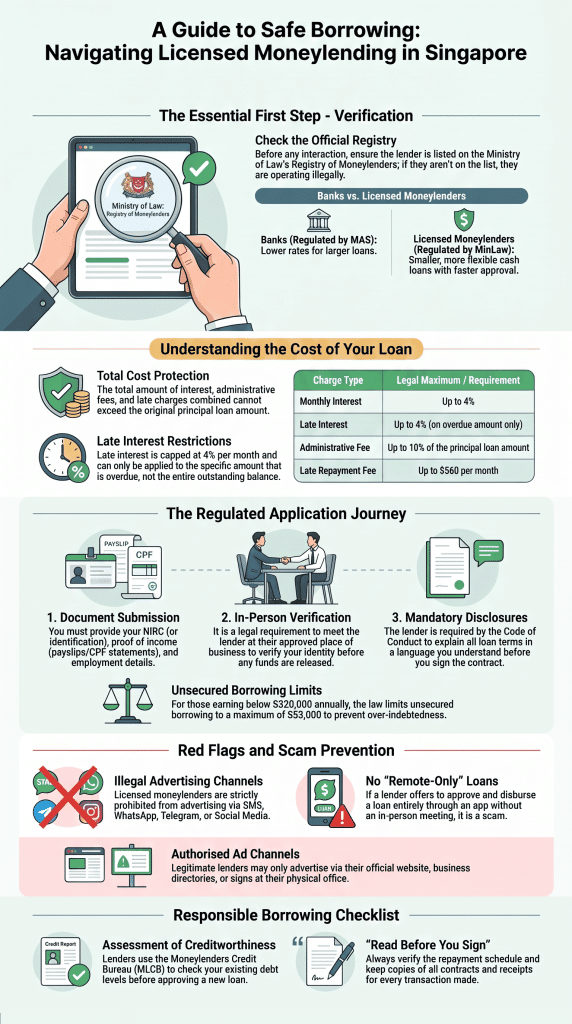
Before a loan is approved, borrowers must complete identity checks and sign a regulated loan agreement.
What Happens During The Application?
- Submit the required documents, including identification, proof of income and employment details.
- Attend in-person verification at the lender’s approved place of business.
- The lender reviews your application and checks your borrowing record, including with the Moneylenders Credit Bureau (MLCB).
- The lender explains the loan terms and conditions in a language you understand before you sign.
- Once everything is completed, the loan is approved, and the funds are disbursed.
Why Is In-Person Verification Important?
- Confirms your identity and helps prevent fraud.
- Meets the requirements of the Moneylenders Act.
- Reduces the risk of identity theft and unauthorised borrowing.
What Mistakes Do Borrowers Commonly Make?

Many borrowing problems can be avoided by checking the lender first and borrowing only what you can afford to repay.
Online borrower discussions regularly highlight the importance of checking the Registry of Moneylenders and keeping copies of loan documents and receipts.
What Should Borrowers Avoid?
- Borrowing without planning how the loan will be repaid. Having a realistic debt repayment plan before borrowing can help reduce financial pressure later.
- Responding to loan offers received through SMS, WhatsApp or other unsolicited messages.
- Signing a loan agreement before reading and understanding it.
- Borrowing more than the legal limit based on income.
How Can Borrowers Reduce Financial Stress?
- Borrow only what you need.
- Compare loan options from different licensed moneylenders.
- Ask questions if anything in the loan agreement is unclear.
- Keep copies of your contract and payment records.
How Can You Borrow Responsibly?
Responsible borrowing begins with knowing what you can comfortably afford to repay.
What Questions Should You Ask Yourself?
- Can I repay this loan on time?
- Do I really need this loan?
- Have I compared other licensed moneylenders?
- Do I understand the interest, fees and repayment schedule?
Responsible Borrowing Checklist
- Work out your budget first.
- Read all fees and interest charges carefully.
- Check every part of the loan agreement before signing.
- Keep your contract and all receipts in a safe place.
Borrowing limits help reduce excessive debt, and licensed moneylenders check a borrower’s existing loans through the Moneylenders Credit Bureau.
Why Do Many Borrowers Choose I-CREDIT?
If you need financial support, choosing a licensed moneylender can give you greater peace of mind. Since 2009, I-CREDIT has provided loan services from its Aljunied office, with clear loan terms, straightforward processes and friendly support throughout the application.
We listen to your situation, explain every step clearly and aim to make the process as hassle-free as possible. As a licensed moneylender, we follow the rules set out under the Moneylenders Act 2008, including limits on interest and fees, as well as mandatory disclosures.
What Does I-CREDIT Offer?
- Licensed lending under the Moneylenders Act 2008.
- Clear loan terms with no hidden surprises.
- Convenient location in Aljunied, with services available for borrowers looking for a licensed moneylender open on Sunday when eligible operating hours apply.
- Personal assistance based on your needs.
- Quick approval for eligible applicants.
Why Verify Any Lender Before Applying?
- Check the lender on the official Registry of Moneylenders.
- Compare loan terms with other licensed lenders.
- Borrow only if the repayments fit your budget.
FAQ
Can a Licensed Moneylender reject my loan application even if I have a stable income?
Yes. A Licensed Moneylender does not approve every Loan Application simply because an applicant has a stable income.
The lender also reviews your credit score, Credit Bureau records, Bank statement, existing financial commitments, and whether you meet the loan requirements. The requested Loan Amount and your ability to repay according to the proposed Loan terms also affect the approval decision.
How can I check whether a Money Lender is legally registered in Singapore?
You can verify a Money Lender by checking the Registry of Moneylenders maintained by the Ministry of Law. The Singapore Registry of Moneylenders publishes the official List of Licensed Moneylenders.
Always confirm that the business details match the official listing before submitting a loan application form. This step helps you avoid Loan Sharks, loan scams, and unlicensed moneylenders posing as legitimate lenders.
What documents do I need when applying for Personal Loans?
The required documents depend on your employment status and the lender’s requirements. Most Personal Loans require your identification documents, Bank statement, and proof of income.
Some applicants may also need CPF statements, SingPass MyInfo, an Employment Pass, a Tenancy Agreement, or an ACRA Business Profile. Providing complete documents helps the lender complete face-to-face verification and process your application more efficiently.
How does a legal money lender calculate the Interest Rate?
A Legal money lender must follow the Moneylenders Act and the applicable Laws and Regulations when charging an Interest Rate. The lender cannot charge more than the legal interest rate ceiling or interest cap.
Many lenders calculate interest using the reducing balance method instead of compound interest. You should carefully review the Loan Contract, processing fees, repayment schedule, and Loan Tenure before accepting any Loan offer.
What should I do if I suspect a loan scam or an illegal moneylender?
If you suspect loan scams or believe you are dealing with unlicensed moneylenders, stop all communication immediately and do not transfer money or provide personal information.
Verify the lender through the Registry of Moneylenders before proceeding. If you believe fraudulent activity has occurred, report the matter to the National Crime Prevention Council or contact the Police hotline. Taking prompt action can help protect you from fraud and unlawful Debt Collection practices.
Borrow With Greater Confidence
Borrowing money can feel stressful, especially when you’re not sure who to trust. A licensed moneylender gives you clear terms and legal protection, so you can make a decision that suits your budget. That’s what matters.
If you’re considering I-CREDIT, check its licence details and compare the loan options before you apply. We listen, we care, and we aim to make borrowing simple with clear guidance and quick approval. Ready to take the next step? Visit I-CREDIT to learn more.
References
- https://sso.agc.gov.sg/Act/MA2008
- https://ctpclc.nus.edu.sg/wp-content/uploads/2016/06/Heartbeats-Volume-2-complete-version.pdf#19#16