i-Credit provides loans to individuals under the Debt Repayment Scheme(DRS). Our loans address the cash flow gap individuals face while under the DRS scheme, which manages an individual’s debt situation.
i-Credit Pte. Ltd. has been a licensed moneylender in Singapore since 2009, licensed by the Ministry of Law. Our office is located at 82 Lorong 23 Geylang, #05-02 ATRIX, Singapore 388409, opposite Aljunied MRT.
Application Form
What is a DRS loan?
A DRS loan is a personal loan from a licensed moneylender for someone already enrolled in the Singapore Debt Repayment Scheme. i-Credit does not help with the DRS application; however, we lend to individuals with cash needs who are under the Debt Repayment Scheme.
DRS freezes interest on your existing debts and gives you a fixed monthly instalment for up to five years, but it does not provide a line of credit or cash when you need it. Banks and credit cards automatically reject individuals under this scheme, and for urgent, unexpected cash needs such as medical bills, the i-Credit DRS loan fills the gap.
What can i-Credit’s DRS loan be used for?
We lend for genuine need. In practice that means:
- Medical and dental costs, for you or a family member
- Funeral and family emergencies
- Essential household costs: rent arrears, utilities, school fees
- Work-related expenses that protect your income: equipment, licence renewals, vehicle repairs, course fees
- A one-off shortfall in an otherwise sound month
We will not lend for speculative purposes, and we do not encourage borrowing for discretionary spending while you are inside a court-supervised repayment plan. If what you need the money for is not on this list, tell us anyway. The answer may still be yes, but it will be an answer to your actual situation.
Click the button below to check your eligibility.
Can you take a loan while you are under DRS?
Yes, individuals under the Debt Repayment Scheme can take on a personal loan but must disclose their DRS status to moneylenders when borrowing amounts over $1,000 SGD.
Banks will decline individuals under DRS for loans; however, i-Credit licensed moneylender can assist.
How does the disclosure work at i-Credit?
DRS status is a question on the application form. You answer it, we record it, and it goes into the file before we make any offer. You are not disclosing something that counts against you here. It is the opposite: it tells us which repayment structure to build. A loan that competes with your DRS instalment is a bad loan, and we would rather size it down than write one.
What happens to your DRS plan?
The loan does not enter the scheme. Your DRS instalment to the Official Assignee stays exactly as it is; it stays your first obligation, and this loan is structured around it rather than alongside it.
What are the risks of taking a DRS loan?
If you fall behind on your DRS obligations, the Official Assignee can issue a Certificate of Failure, which terminates the scheme and allows your creditors to restart bankruptcy proceedings against you.
At i-Credit, we always check your DRS instalment status and assess your ability to repay before extending a loan. More often, a borrower may request a certain amount, but we assess that they can only borrow less to ensure they do not fall behind on their obligations.
Some people search for this as being “under debt review” rather than under DRS. Same scheme, same answer.
How to apply for i-Credit's DRS Loan?

Marcus
i-Credit Loan Officer. Aljunied Branch
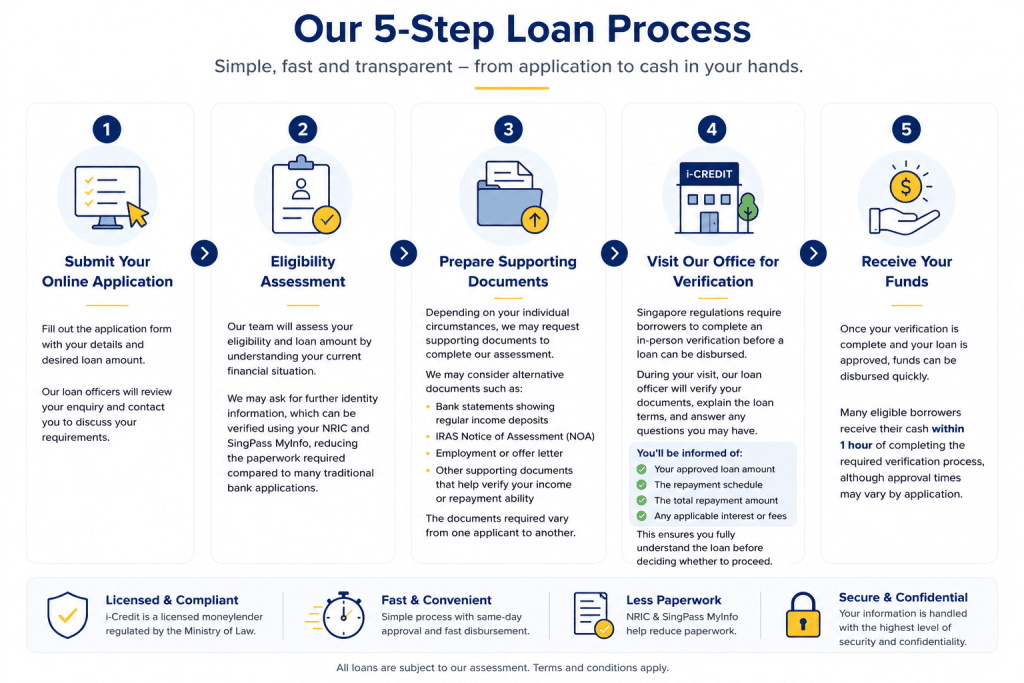
1. Submit the online form. Name, contact, income, and your DRS status. Two minutes.
2. We call you, usually the same working day. We will ask for your DRS instalment amount and your take-home pay, and give you an indication before you travel to the office.
3. Come to the Aljunied office with your documents. This step is not optional and it is not us being difficult. Licensed moneylenders are legally required to verify a borrower’s identity in person at the licensed address before granting a loan. Anyone offering to complete a loan entirely over WhatsApp or transfer money without meeting you is not licensed.
4. Sign and collect. You receive the loan contract, a copy of the repayment schedule, and the funds. Same visit, where documents are in order.
We are at 82 Lorong 23 Geylang, #05-02 ATRIX, Singapore 388409, directly opposite Aljunied MRT and one stop from Paya Lebar and Kallang. Open Monday to Friday 11am to 8pm, Saturday and Sunday 11am to 4pm.
Who we lend to: four DRS situations
DRS participants have to be gainfully employed with regular income. That is a MinLaw entry condition. So every person under DRS is, by definition, an employed borrower with documented income and a court-supervised repayment record.
Here are the four situations we see most.
You are mid-plan, and something urgent has come up
You are two years into a five-year plan. You have not missed an instalment. Then your father needs a S$2,000 deposit for a procedure this week, or the car you drive to work fails its inspection. Every bank sees the DRS flag and declines before a human reads the file.
What we need from you: your NRIC, your last three payslips, your CPF contribution history, and something showing your DRS status, usually correspondence from the Official Assignee. What we do with it: size a loan against what is left after your DRS instalment, not against your gross income.
You have just been referred, and the plan has not started yet
The bankruptcy application has been referred to the Official Assignee, the suitability review is underway, and you are in the thirty-to ninety-day gap before the plan formally begins. Bank credit is already gone. The plan that will fix things has not started.
Say so on the application. This stage is different from being under an active plan, your monthly obligation is not yet fixed, and we assess it differently. In some cases we will ask you to come back once the plan is confirmed and the instalment is known, because the alternative is guessing at your affordability. That is not a decline, it is a timing call, and we will tell you which one it is.
You are short on this month's DRS instalment
Read this one carefully, because the honest answer may not be the one you came for.
A small bridging loan can cover a genuine one-off shortfall: a month where hours were cut, or a delayed reimbursement. It cannot fix a plan that has become unaffordable. If your instalment is beyond your income every month, not just this month, borrowing to pay it adds a second obligation to a first one you already cannot meet, and it brings the Certificate of Failure closer rather than pushing it away.
If that is where you are, call the Official Assignee before you call us. The instalment can sometimes be reviewed. Credit Counselling Singapore is free and independent. We would rather you go there and keep the plan than borrow here and lose it.
You want to keep working, and the cost of working is the problem
Work equipment, a course or licence renewal, a delivery bike repair, relocation to be nearer a job. Income is what keeps a DRS plan alive, so spending that protects income is the strongest case a borrower under DRS can bring us, and we treat it that way.
How i-Credit lends to DRS participants, and what it costs
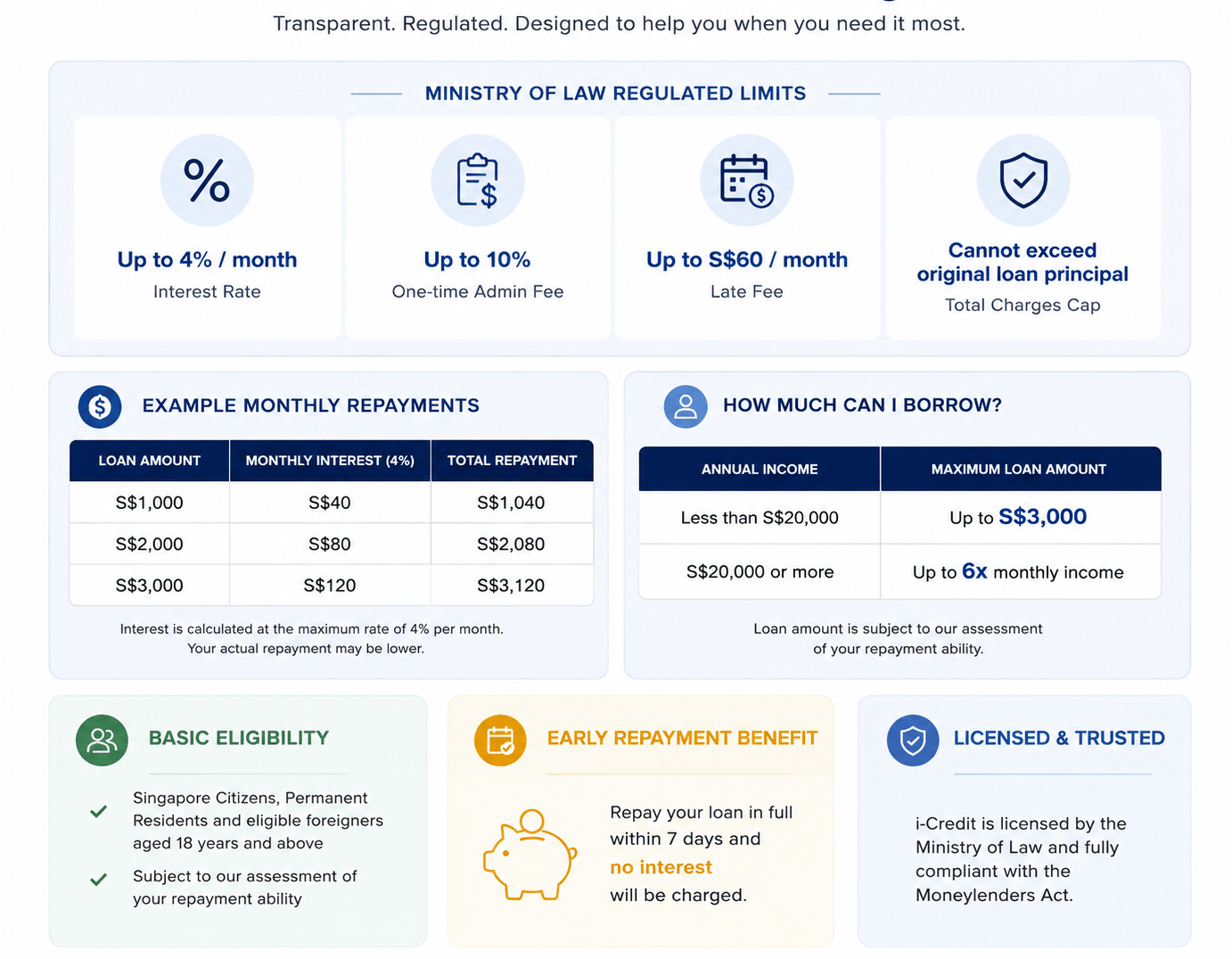
Every charge below is capped by the Moneylenders Rules. The caps are law and apply to every licensed moneylender in Singapore. Any lender quoting you more than these figures is not licensed.
| Interest rate | Up to 4% per month |
| One-time administrative fee | Up to 10% of the loan principal |
| Late payment fee | Up to S$60 per month |
| Total charges | Cannot exceed the original loan principal |
Example Monthly Repayment
DRS loan Repayment Options
Terms are set around your DRS instalment date so the two do not collide. You will get the full schedule in writing before you sign, and you have the right to a copy of the loan contract and to a statement of account at any time.
How the Debt Repayment Scheme works
The Debt Repayment Scheme is administered by the Official Assignee at the Ministry of Law. It lets a debtor with unsecured debts not exceeding S$150,000 repay them through a fixed monthly instalment over a maximum of five years, without being made bankrupt, without a public bankruptcy record, and with interest on those debts frozen.
One correction, because nearly every page on this topic gets it wrong: you cannot apply for DRS directly. There is no application form. Entry is through a bankruptcy application filed in the High Court, which the court may then refer to the Official Assignee for a suitability review. If the review clears you, the plan starts.
Full detail, including the Official Assignee’s fee schedule, the eligibility criteria and how to check your status, is in our guide to debt repayment scheme.
Frequently asked questions about i-Credit DRS loan
Can I take a loan while I am under DRS?
Yes. Being under DRS does not prohibit borrowing, but you must not take on further credit above S$1,000 without disclosing your DRS status to the lender.
Will taking this loan affect my DRS plan?
The loan does not enter your DRS. Your instalment to the Official Assignee stays the same and stays your first obligation, and we size and schedule the loan around it. The risk is only in over-borrowing: a repayment you cannot meet on top of the DRS instalment puts the plan at risk.
Can I get a loan if I am under debt review?
Yes, on the same terms. “Under debt review” is how some people describe being under the Debt Repayment Scheme. Disclose it, and we lend against what is left after your monthly instalment.
How much can I borrow while under DRS?
he amount is based on your income and what remains after your DRS instalment. We assess affordability after the instalment, not before it, which usually means a smaller loan than your gross salary would suggest.
Can I apply for DRS through i-Credit?
No, and neither can anyone else. There is no direct application for DRS. Entry is through a bankruptcy application filed in the High Court, which the court may refer to the Official Assignee for a suitability review. i-Credit lends to people already on the scheme. For the scheme itself, see the Ministry of Law Insolvency Office.
Can self-employed or freelance workers apply?
Yes. Self-employed individuals, freelancers, gig workers, commission-based employees, and applicants with irregular income may still be eligible. Every application is assessed individually based on your financial situation and ability to repay the loan.
How is a DRS loan different from a debt consolidation plan?
Consolidation Plan is a bank product that requires unsecured debt of at least twelve times your monthly income, and it is not open to you once you are under DRS. A DRS loan is a licensed moneylender loan to someone already on the scheme. One consolidates old debt; the other provides new cash while the scheme runs.
Can a bankrupt person get this loan?
ot through this page. DRS and bankruptcy are mutually exclusive, and an undischarged bankrupt is not eligible for DRS. If you are an undischarged bankrupt, see loans for bankrupts in Singapore.