

A bank personal loan is usually cheaper, while a licensed moneylender loan may be faster and easier to access. So, the right choice depends on how much you need, how soon you need the money, and what you can afford to repay.
Banks often offer higher loan amounts and lower interest rates, but their checks can be stricter. Licensed moneylenders may review applications faster and accept more types of income documents. But the total borrowing cost can be higher.
Before you decide, check the interest, fees, loan amount and repayment terms. Don’t rush into a loan because you need cash quickly.
Quick Guide: Bank vs Licensed Moneylender
Here’s the short version of what matters most when choosing between a bank personal loan and a licensed moneylender in Singapore:
- Banks suit larger, planned borrowing with stable income and standard documents. Licensed moneylenders may suit smaller, urgent needs.
- Compare the full borrowing cost. Check the EIR, fees, monthly installment, loan tenure, and total repayment.
- Check the lender before borrowing. Verify the lender with the official Registry of Moneylenders, and make sure the repayment fits your budget.
Bank Vs Licensed Moneylender: What Is The Difference?
The main differences are loan amount, approval speed, eligibility, and cost.
| Factor | Bank Personal Loan | Licensed Moneylender Loan |
| Loan quantum | Usually larger | Usually smaller, subject to statutory limits |
| Approval | Often slower | Potentially faster |
| Income screening | More standardised | May accept alternative income evidence |
| Credit checks | Detailed | Assessment still required |
| Interest | Usually lower headline rate | Up to 4% per month |
| Best for | Larger, planned expenses | Smaller or urgent financial needs |
| Main drawback | Stricter requirements | Higher potential borrowing cost |
A bank may suit you if you have a steady income, a good credit record and time to complete the checks. But if you need money sooner, a licensed moneylender may be an option. This also applies if your income is freelance, self-employed, or irregular.
If you want to understand how unsecured borrowing works, see this guide to unsecured personal loan options in Singapore.
Still, faster approval doesn’t mean lower cost. Check the full repayment amount, fees and loan terms before signing. Don’t look at the interest rate alone.
How Much Can You Borrow?
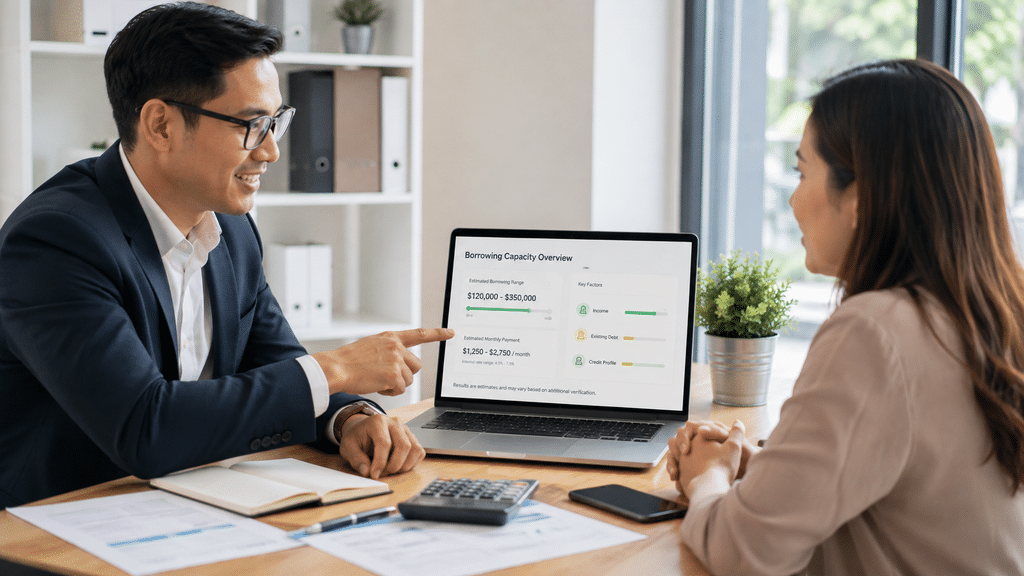
Banks decide your approved loan quantum based on your income, credit record and ability to repay. Licensed moneylenders must follow statutory borrowing limits.
For unsecured loans, Singapore Citizens and Permanent Residents earning below S$20,000 a year may generally borrow up to S$3,000. If you earn at least S$20,000 a year, you may generally borrow up to six times your monthly income, subject to the rules and the lender’s assessment.
These limits apply across licensed moneylenders. You can’t borrow the full limit again from each lender.
So, a moneylender loan in Singapore option may suit smaller needs, such as:
- Urgent household or medical bills
- Essential repairs
- Short-term cash-flow gaps
- Work-related expenses
For borrowers looking specifically at short-term borrowing, cash loans may be another option to consider, depending on the amount needed and repayment terms.
A bank personal loan may be a better fit for a larger planned expense, such as home renovation or education costs. But that doesn’t mean you should borrow more than you need. Borrow only what you can repay.
Which Loan Has Easier Eligibility And Faster Approval?
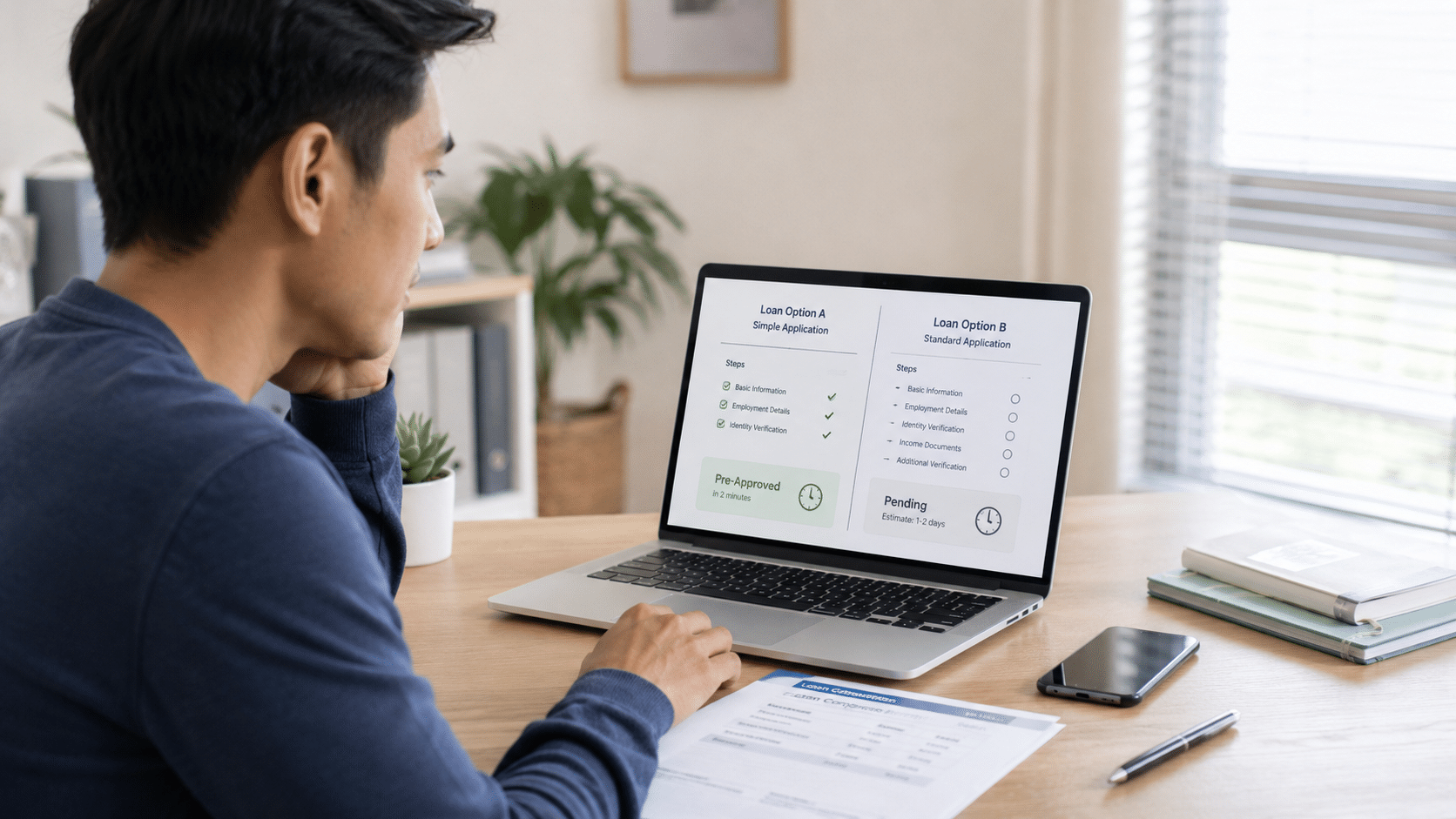
Banks usually carry out detailed income and credit checks. You may need payslips, CPF records, tax documents, employment details or bank statements.
The process can take longer if your income isn’t standard. Freelancers, self-employed workers, commission-based staff and gig workers may need extra documents to show regular earnings.
Licensed moneylenders must also check whether you can repay the loan. But some may accept other forms of income proof, such as bank statements, contracts or invoices.
Approval may also be faster. For example, i-Credit states that eligible applicants who supply the required information can receive an initial assessment within 1 to 2 hours.
After an in-person face-to-face verification and contract signing at their approved office, as required by law, same-day cash collection may be available.
That can help if an essential bill can’t wait. But speed isn’t the only thing to check. Look at the interest, fees and monthly instalment too. Make sure the repayment fits your budget before signing.
If you have a weaker credit history, you can also learn more about bad credit loan Singapore options and the factors lenders may consider.
How Much Does A Licensed Moneylender Loan Cost?
The Ministry of Law caps the interest that licensed moneylenders can charge at 4% per month. There are also limits on certain fees and late charges.
| Charge | Statutory Maximum |
| Interest | 4% per month |
| Late interest | 4% per month on the amount repaid late |
| Upfront administrative fee | 10% of principal |
| Late-payment fee | S$60 per month |
| Total charges | Cannot exceed the original principal |
The 4% monthly rate is the legal maximum, calculated on a reducing balance basis rather than a flat rate. A licensed moneylender is not obliged to charge the maximum rate.
Also, don’t compare a monthly moneylender rate directly with a bank’s annual rate. The calculations are different. Look at the effective interest rate, fees, loan tenure, monthly instalment and total repayment instead.
Insights from MoneySense indicate
“Use the effective interest rate to compare different loans to get the best rate” – MoneySense
A longer loan term can lower each monthly payment. But you’ll usually pay more over the full loan period.
How Should You Compare The Total Cost?
Credits: CNA
A proper personal loan comparison Singapore should look at the full cost, not the advertised interest rate alone.
Before choosing a loan, check:
- Interest rate and EIR
- Processing or administrative fees
- Loan tenure
- Monthly instalment
- Total repayment
- Early repayment terms
- Late-payment charges
For bank loans, compare the EIR and total repayment across different products. For licensed moneylenders, check the monthly interest, permitted fees and full repayment schedule.
As highlighted by Ministry of Law
“EIR better reflects the actual cost of borrowing” – Ministry of Law
A lower monthly instalment doesn’t always mean a cheaper loan. If the loan runs for longer, you could pay more interest overall. That’s an easy detail to miss.
Look at the total. The key question is simple: How much will you pay in total to borrow the amount you need?
When Is A Bank Personal Loan Better?
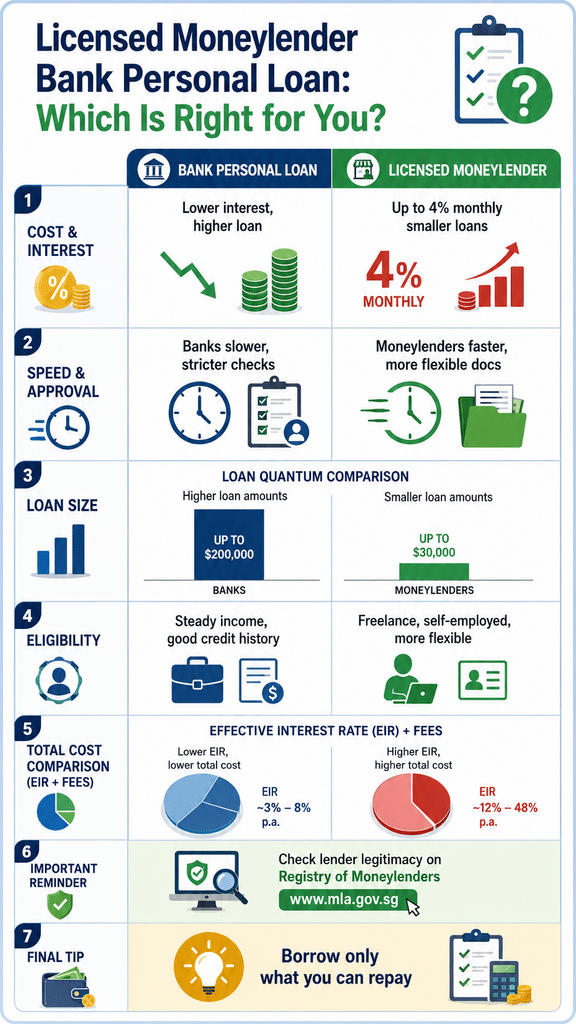
A bank personal loan may suit you if you need a larger amount, have steady income and meet the bank’s requirements.
It may be a good fit if you:
- Need a larger loan quantum
- Have stable employment or regular income
- Can provide standard income documents
- Have an acceptable credit profile
- Can wait for the bank’s assessment
- Can afford the EIR and total repayment
For a planned expense, such as home renovation, you may have time to compare several bank personal loan Singapore options.
Banks may also offer longer repayment periods for some loans. But check the total interest before choosing a longer tenure. Lower monthly payments can mean a higher total cost.
And don’t assume a lower advertised rate means a cheaper loan. Fees, loan tenure, approved amount and promotional terms can change what you pay.
When Is A Licensed Moneylender Better?
A couple at home comparing Licensed Moneylender vs Bank Personal Loan options on a laptop with budget sheets nearby
A licensed moneylender may suit you if you need a smaller amount, have an urgent expense or don’t have standard income documents.
It may be an option if you:
- Need money quickly for an essential expense
- Need a smaller loan amount
- Are self-employed or freelance
- Earn commission or gig income
- Have limited payslip records
- Need alternative income documents
- Can afford the repayments
The trade-off is clear: faster access and more flexible income documents can mean a higher borrowing cost.
If you are unfamiliar with how this type of lender operates, read what is a licensed moneylender in Singapore before applying.
Licensed moneylenders operate under the Ministry of Law’s rules. They must also give borrowers the required loan information and contract.
If you’re considering i-Credit, the company says it has operated since 2009 and offers personal financing for people with different income profiles. Its published information also mentions self-employed people, freelancers, gig workers and commission-based employees.
Depending on your situation, i-Credit says it may consider documents such as bank statements, contracts and invoices.
So, speed and flexible income checks may be the main reasons to consider an option such as i-Credit. But don’t assume it’ll be cheaper than a bank loan. Check the full repayment cost first.
FAQ
What documents do I need for a personal loan application in Singapore?
Lenders commonly ask for proof of identity, payslips, bank statements, and CPF contribution statements. They may also check your employment status, income, and credit history when assessing your application. Requirements differ between lenders, so review the relevant bank loan requirements or moneylender eligibility criteria before applying. Preparing these documents in advance can help avoid unnecessary delays.
How should I compare personal loan interest rates in Singapore?
Do not compare personal loan interest rates alone. Check the effective interest rate, processing fee, administrative fee, late payment fee, and early repayment fee. These charges affect your total borrowing costs. Compare the total cost of borrowing and monthly loan repayment for each offer. This approach can help you identify a suitable loan option for your budget.
Can I get a loan with a low credit score?
A low credit score can affect your chances of approval, but it does not automatically prevent you from borrowing. Lenders may consider your income, existing debts, employment status, and credit history during their credit assessment. If you have a low credit score, borrow only what you can afford to repay and avoid taking on additional debt that could strain your finances.
How quickly can I receive money after applying for a loan?
The time required depends on the lender, your eligibility, and whether you provide all required documents. Some loan applications may receive approval faster than others, but no lender can guarantee an instant loan in every case. If you have urgent financial needs, prepare your identification and proof of income before submitting the application to help prevent avoidable delays.
How much should I borrow for an urgent financial need?
You should borrow only the amount you need and can comfortably repay. Before applying, review your monthly income, existing debts, and regular expenses to assess your debt repayment capacity. Consider the loan tenure and monthly loan repayment, not just the amount you receive. Choosing a smaller loan can help keep your borrowing costs and repayment burden manageable.
Choose the Loan That Fits Your Situation
A bank personal loan can work well for a larger planned expense when you have steady income and time to compare offers. A licensed moneylender may be more practical when you need a smaller amount quickly or your income documents aren’t standard. The key is choosing an option you can comfortably repay.
Before you sign, check the lender, contract and total repayment amount. Don’t focus only on the monthly instalment. If you’re considering i-Credit, compare its loan terms with other options and make sure the repayment fits your budget. If you need a faster option, review i-Credit’s loan options and decide if they suit your needs.
References:
- https://www.mlaw.gov.sg/news/press-releases/amendments-to-the-moneylenders-rules-to-take-effect-from-1-june-2012/
- https://www.moneysense.gov.sg/costs-of-borrowing-flat-rate-monthly-rest-and-effective-interest-rate/